

War by Loophole: How Target Lists Are Being Rewritten.
As pressure mounts, the Pentagon searches for “legal” strikes in a war running out of options.

Small Bites is a reader-supported publication. To receive new posts and support my work, consider becoming a paid subscriber.
Hey Small Biters,
The war is entering a new phase—not of escalation, but of justification.
Inside the Pentagon, planners are quietly revising what counts as a legitimate target. The shift is subtle on paper, but massive in consequence: expanding strike options to include infrastructure that serves both civilians and the military.
It’s not a strategy of victory. It’s a strategy of explanation. At the center of it all is Donald Trump, who finds himself boxed in by the limits of modern warfare. After weeks of relentless airstrikes, the obvious military targets inside Iran have largely been exhausted.
What remains are harder choices. On one side lies escalation—deploying ground troops into a conflict that already shows signs of spiraling beyond control. On the other lies something even more controversial: striking civilian infrastructure, an act widely considered illegal under international law.
So a third path has emerged. Call it the gray zone. Call it the workaround. Call it what it is: war by loophole. Defense officials now argue that certain infrastructure—power plants, fuel systems, even water facilities—can be deemed legitimate targets if they are used in part by military forces. These so-called “dual-use” sites sit at the intersection of necessity and legality and that intersection is where wars get murky.
American and Israeli aircraft, after five weeks of near-constant strikes, are searching for what’s left. The revised target lists are not just tactical documents—they are legal shields because the accusation looming over all of this is clear: war crimes.
Trump himself has not softened his rhetoric. He has openly threatened to destroy Iran’s bridges, power plants, and critical infrastructure if Tehran does not bend. The language is blunt. The implications are not.
Internally, however, officials appear less certain. Debate continues over where exactly the line should be drawn. Is a desalination plant a civilian necessity—or a military asset if soldiers drink from it?
Is electricity a utility—or a weapon? The answers depend less on physics and more on framing.
The Geneva Conventions allow for some flexibility when targets serve both civilian and military purposes. But that flexibility is not infinite. The principle of proportionality still applies, and civilian harm cannot be excessive relative to military gain. That’s where the unease creeps in.
Legal experts acknowledge the gray area, but they also warn how easily it can be abused. Sean Timmons, a former Army legal officer, noted that while dual-use targets can be lawful, the risk of overreach is real—and growing.
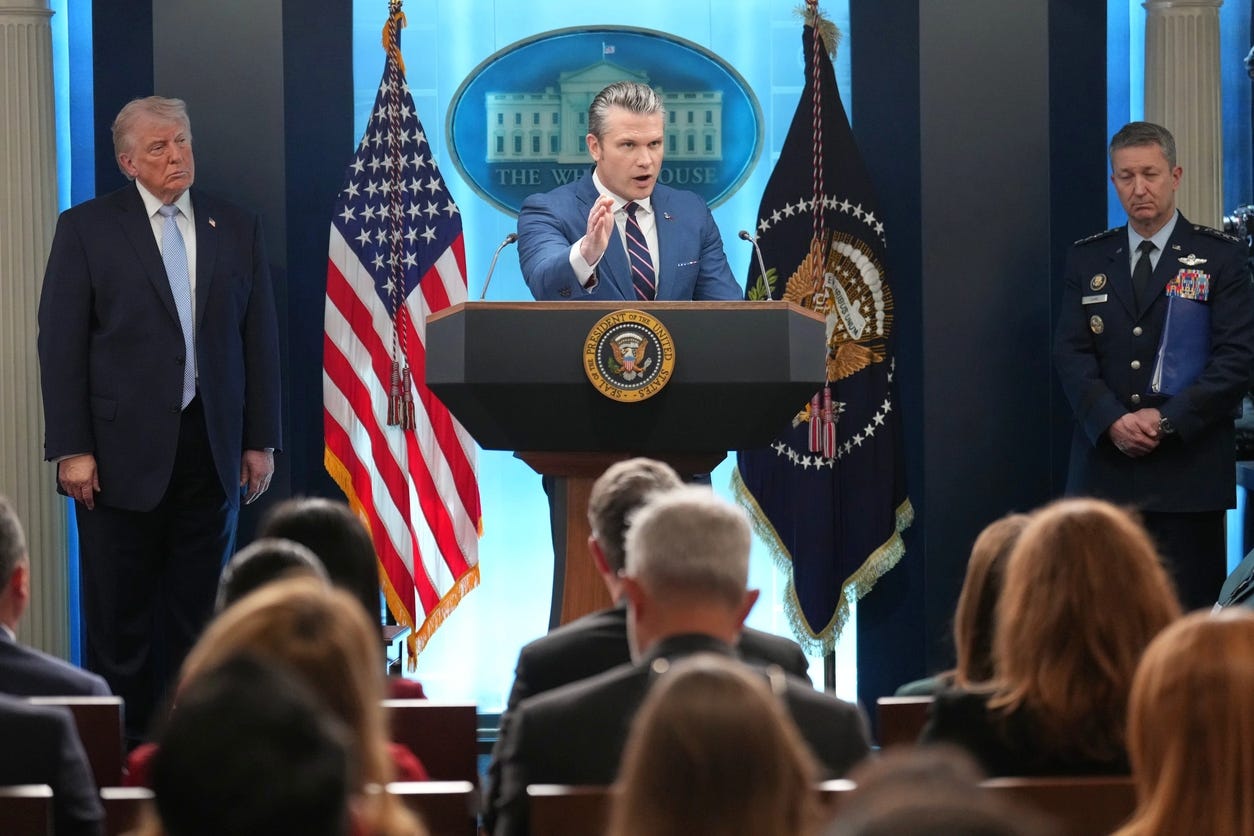
Checks and balances are supposed to exist. But those checks may be thinning. Defense Secretary Pete Hegseth has significantly reduced the internal infrastructure designed to prevent civilian harm. Offices tasked with reviewing targeting decisions have been cut dramatically, shrinking both oversight and accountability.
Even the number of military lawyers—those responsible for ensuring operations comply with the law—has been reduced. Less oversight. More ambiguity. A dangerous combination.
At the same time, the White House insists that no final decision has been made. Press Secretary Karoline Leavitt framed the Pentagon’s planning as routine—providing “maximum optionality” for the commander-in-chief.
Optionality is a polite word. It means every door remains open. Trump, for his part, has gone further. He suggested that Iranian civilians might accept the destruction of infrastructure if it leads to regime change, arguing they “want us to keep bombing.”
It is a claim that is impossible to verify—and easy to weaponize. Because if civilian suffering is reframed as liberation, then almost any action can be justified.
Critics have been swift to respond. The Council on American-Islamic Relations condemned the threats as reckless and indicative of a disregard for human life. Their concern is not just about what is being planned, but about how it is being rationalized.
Because once the logic shifts, the boundaries follow. There is also a strategic contradiction at play. Trump has repeatedly called for the Iranian people to rise against their government. But crippling civilian infrastructure—electricity, water, fuel—risks turning public anger outward rather than inward.
Suffering rarely produces compliance. More often, it produces resistance. And resistance has a way of prolonging wars. The United States has already struck more than 13,000 targets inside Iran. The scale is staggering. The results, less clear.
What remains is a conflict searching for an endgame and in that search, definitions are becoming as important as decisions. The Pentagon’s evolving target list is more than a tactical adjustment. It is a signal—a sign that the war is no longer just being fought on the battlefield, but in the legal and moral frameworks that define it.
And when wars move into that space, the lines don’t just blur. They disappear.
✍️
When the map runs out of targets,
the language begins to stretch.
When the rules feel inconvenient,
definitions do the heavy lifting.Bomb the lights,
and call it dawn.
Break the system,
and call it reborn.
🧭 A Small Bite to Carry
The Pentagon is expanding “dual-use” targets, creating a legal gray zone between military necessity and civilian harm.
Reduced oversight inside the Defense Department raises concerns about accountability in strike decisions.
As options narrow, the war is shifting from strategy to justification—where definitions may matter more than outcomes.
US Stocks
Stocks maintain gains after whipsawing as traders digest war updates.
The S&P 500, Nasdaq 100, and Russell 2000 managed to maintain gains, and oil rose amid a volatile session. Traders vacillated between hopes for a ceasefire and fears of an escalation after President Trump said the entire country of Iran could be taken out in one night, “maybe tomorrow.”
Friday’s jobs report showed that US hiring surged in March, as job growth of 178,000 crushed estimates of 65,000, and the unemployment rate unexpectedly dipped to 4.3%, below the 4.4% expected by economists.
This was statistically the most boring trading day in US stocks since the war began.
The daily range in the SPDR S&P 500 ETFSPY $657.82 (0.47%) as a share of the previous session’s closing price was just 64 basis points. That’s the least volatile intraday action since February 25 — before the US-Israeli strikes on Iran.
BNYBNY $10.20 (0.21%) and RobinhoodHOOD $69.67 (1.28%) ticked higher after being tapped by the Treasury department to run “Trump accounts” for children.
AppLovinAPP $410.99 (6.82%) surged as Wells Fargo boosted its price target to $560 from $543.
What Else Are We Biting
OpenAI’s leadership reportedly disagrees about when to raise money and how to spend it.
Paramount receives $24 billion from Gulf funds to back its Warner Bros. takeover.
Anthropic boasts revenue run rate of $30 billion as the Claude developer expands its partnership with Google and Broadcom.
Biting Fact Of The Day
There are currently 10 toilets in outer space.

At the center of it all is Donald Trump, who finds himself boxed in by the limits of modern warfare. After weeks of relentless airstrikes, the obvious military targets inside Iran have largely been exhausted.