

UN warns as sea level rise doubles in 10 years
A sweeping UN report warns that rising seas, warming waters, plastic pollution, and overexploitation are pushing the world’s oceans toward a dangerous tipping point.

Small Bites is a reader-supported publication. To receive new posts and support my work, consider becoming a paid subscriber.
Hey Small Biters,
The world’s oceans are sending an unmistakable warning. For decades, scientists have cautioned that human activity was placing extraordinary stress on marine ecosystems. A new United Nations assessment now suggests that those warnings were not only justified, but may have understated the speed at which the crisis is unfolding.
According to the UN’s latest World Ocean Assessment, the health of the world’s oceans is deteriorating at an alarming pace. The report paints a sobering picture of rising sea levels, record ocean temperatures, mounting plastic pollution, declining biodiversity, and ecosystems struggling to withstand an ever-growing list of human pressures.
Researchers describe the situation as one of “severe and accelerating” stress. That phrase is not scientific exaggeration. It is a conclusion reached by nearly 600 scientists from 86 countries who contributed to one of the most comprehensive examinations of ocean health ever conducted.
The findings suggest that the ocean systems humanity relies upon are being pushed harder than at any point in modern history. One of the most alarming findings involves sea-level rise. Before 2015, global sea levels were rising at roughly two millimeters per year. By 2023, that rate had more than doubled to approximately 4.3 millimeters annually.
The increase may appear small on paper. In reality, it represents a massive acceleration with profound implications for coastal communities, infrastructure, agriculture, and millions of people living near shorelines.
Scientists warn that higher seas amplify flooding, erosion, storm surges, and saltwater intrusion into freshwater supplies. Communities that once viewed these dangers as distant threats are increasingly experiencing them in real time. The report also reveals how rapidly the oceans are heating.
Remarkably, sixteen percent of all ocean heat accumulated since 1955 has been absorbed during the period after 2018. That statistic illustrates just how dramatically conditions have changed within only a few years. The ocean acts as Earth’s largest climate buffer. Without it, global temperatures would be significantly higher than they already are.
The problem is that this protective role comes at a cost. As oceans absorb more heat, marine ecosystems face increasing disruption. Researchers found that some of the most significant warming is occurring in the Atlantic Ocean and portions of the Indian and Pacific Oceans. Those changes affect everything from weather patterns to fisheries and marine migration routes.
Ocean currents that have remained relatively stable for centuries are beginning to shift. Scientists acknowledge that many of the long-term consequences remain poorly understood. That uncertainty itself is alarming. The ocean drives climate systems across the entire planet.
Changes in circulation patterns can trigger cascading effects far beyond the coast. The report emphasizes that major knowledge gaps still exist. Despite centuries of exploration, only about 27 percent of the ocean floor has been mapped. Vast portions of the deep sea remain largely unexplored. Entire ecosystems may exist beyond humanity’s current understanding.
This means that some environmental damage could be occurring in places scientists have barely begun to study. The ocean covers more than seventy percent of the planet’s surface. Its influence extends into nearly every aspect of human life.
It regulates climate. It produces food. It supports global commerce. It sustains biodiversity. It provides energy and countless economic opportunities. Most importantly, it helps stabilize the environmental systems that make human civilization possible. The report notes that oceans have absorbed roughly ninety percent of the excess heat generated by greenhouse gas emissions.
They have also absorbed approximately thirty percent of the carbon dioxide released through fossil fuel consumption. Those services have shielded humanity from even greater climate disruption. Yet the capacity of the oceans to absorb endless stress is not unlimited. Scientists warn that critical thresholds may be approaching.
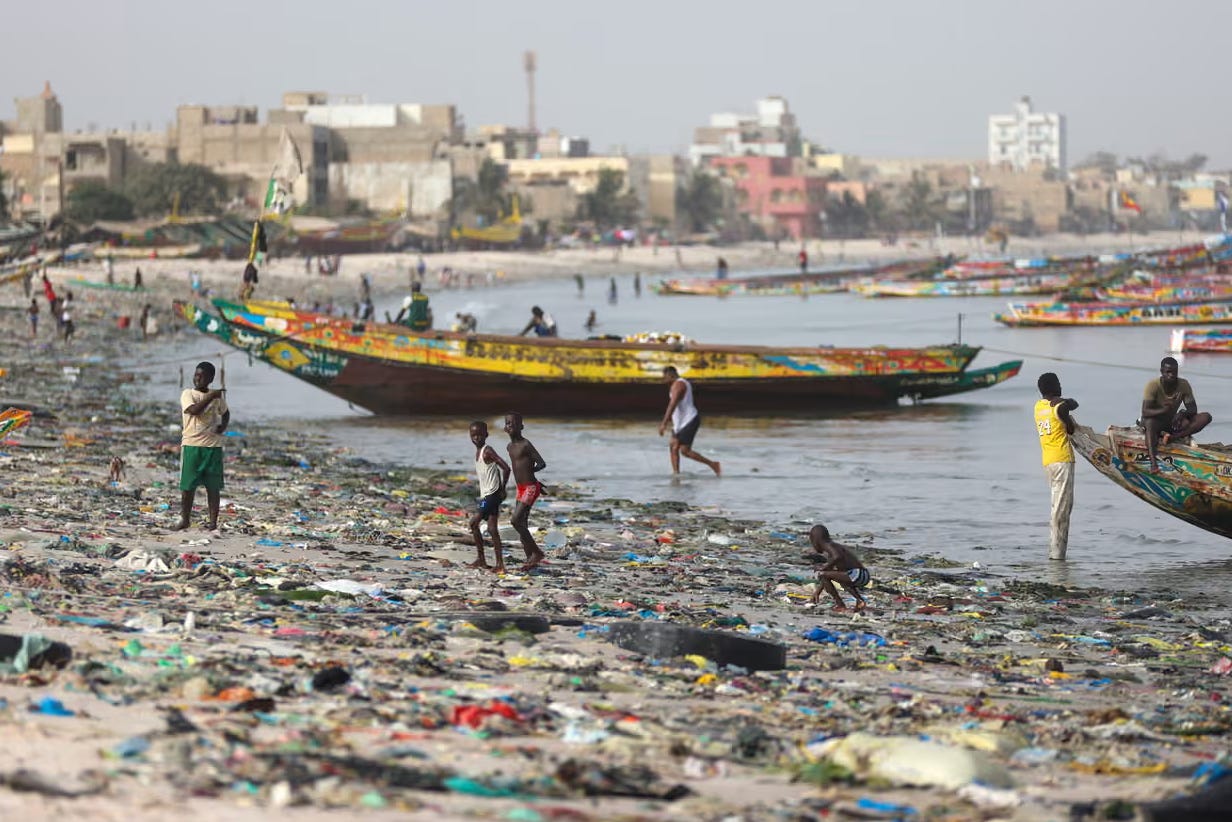
Plastic pollution remains another growing concern. The report estimates that more than fifty-two million metric tons of plastic enter the oceans every year. Those materials eventually break down into microscopic fragments. Today, researchers estimate there are approximately 24.4 trillion microplastic particles floating throughout the marine environment.
The scale is almost impossible to comprehend. Microplastics have already been detected in thousands of marine species. They are found in fish, shellfish, seabirds, and even remote ecosystems far from human population centers. Industrial fishing continues to place additional pressure on already stressed ecosystems.
Many marine species face mounting challenges from habitat destruction, warming waters, pollution, and over harvesting simultaneously. Scientists increasingly view these pressures not as separate problems but as interconnected threats. The cumulative impact is proving particularly destructive.
One stressor weakens an ecosystem. Several together can push it toward collapse. The report highlights progress as well. International agreements, including the recently implemented High Seas Treaty, have strengthened protections for vast areas of ocean beyond national jurisdiction.
Several dozen global agreements now exist to address conservation, biodiversity, and resource management. Those achievements demonstrate that international cooperation remains possible. Unfortunately, the report also concludes that governance remains fragmented and inconsistent.
Enforcement gaps continue limiting the effectiveness of many protections. Population growth adds another layer of pressure. The world’s population expanded from approximately 7.7 billion people in 2017 to more than 8.2 billion by late 2024. More than one-third of humanity lives within 100 kilometers of a coastline.
Roughly eleven percent live on land less than ten meters above sea level. These numbers underscore how deeply connected human well-being is to ocean health. When the ocean changes, communities change with it. Economic systems change with it. Food security changes with it.
UN Secretary-General António Guterres urged nations to rethink their relationship with the ocean. His message was simple but urgent. Humanity can no longer treat the oceans as limitless. The assumption that the sea will endlessly absorb pollution, heat, and exploitation is proving increasingly dangerous. The report’s central message is not one of hopelessness.
It is one of accountability. The science is becoming clearer. The consequences are becoming more visible. The solutions are increasingly understood. What remains uncertain is whether governments will act quickly enough. The oceans have carried humanity’s burdens for generations. They have absorbed our pollution, buffered our warming climate, and fed billions of people around the world. The latest UN assessment suggests those systems are now approaching their limits.
What happens next will depend not on what scientists discover, but on what governments, industries, and societies choose to do with what they already know.
✍️
The sea remembers every scar,
Every ship and factory afar.
Every plume of smoke that climbed the sky,
Returns one day with a rising tide.The ocean carried our excess heat,
Shielding cities from greater defeat.
Yet every burden has a price,
Measured now in warming tides.We mapped the moon and distant space,
Yet much of Earth remains a place,
Where darkness hides what few have seen,
Beneath the ocean’s shifting green.Bottle to fragment, fragment to dust,
Carried by currents because we must.
The ocean keeps what we throw away,
Returning the bill another day.
🧭 A Small Bite to Carry
The UN warns that the world’s oceans are under severe and accelerating stress from climate change, pollution, and industrial exploitation.
Sea-level rise has more than doubled over the past decade, while ocean temperatures continue to break records.
Scientists say stronger international cooperation and faster conservation efforts are essential to prevent further damage to critical marine ecosystems.
US Stocks
Stocks climb higher as traders buy the dip in chip stocks
The S&P 500, Nasdaq 100, and Russell 2000 all climbed higher. The iShares Semiconductor ETFSOXX $570.08 (5.76%) surged to one of its best days of the year as chip stocks rebounded.
Information technology, energy, and consumer discretionary were the only sectors to outperform the S&P 500. Utilities was today’s worst performer.
Oil prices rose as Israel and Iran traded strikes on each other, but pared steeper gains on news that the countries have halted their attacks.
NvidiaNVDA $207.65 (1.73%) rose on a multiyear partnership with SK Hynix and other South Korean companies focused on memory chips and the AI data center build-out.
IntelINTC $109.82 (11.10%) surged on a report from The Information that NvidiaNVDA $207.65 (1.73%) and AlphabetGOOG $360.70 (-1.20%) are considering it as a backup chipmaker.
AppleAAPL $300.67 (-1.87%) slipped as investors appeared underwhelmed by its latest attempt to integrate AI and Siri.
What Else Are We Biting
OpenAI files confidentially for IPO.
Paramount reportedly offers concessions to resolve multistate antitrust investigation.
Pentagon says Alibaba, Baidu, BYD, and Unitree support China’s military.
Biting Fact Of The Day
Crypto digital asset treasuries have shed $62 billion in market cap since October.

According to the UN’s latest World Ocean Assessment, the health of the world’s oceans is deteriorating at an alarming pace. The report paints a sobering picture of rising sea levels, record ocean temperatures, mounting plastic pollution, declining biodiversity, and ecosystems struggling to withstand an ever-growing list of human pressures.
Oh crap, I live 20 blocks from the UN. Maybe I will look for an apartment on the 21st floor instead