

Florida Justices Allow Controversial Republican Maps to Stand for 2026.
Florida’s highest court clears the way for Republican-backed congressional maps that could reshape the balance of power in Washington for years to come.

Small Bites is a reader-supported publication. To receive new posts and support my work, consider becoming a paid subscriber.
Hey Small Biters,
Florida Republicans secured a major political victory this week after the state Supreme Court allowed a controversial new congressional map to remain in place for the 2026 midterm elections. The maps, drawn by Florida Gov. Ron DeSantis, will be used for the 2026 midterm elections. It was designed to help Republicans gain up to four additional House seats.
The ruling marks another important win for Governor Ron DeSantis and for broader Republican efforts to redraw congressional districts ahead of a fiercely contested election cycle. For Democrats and voting rights advocates, however, the decision represents something very different.
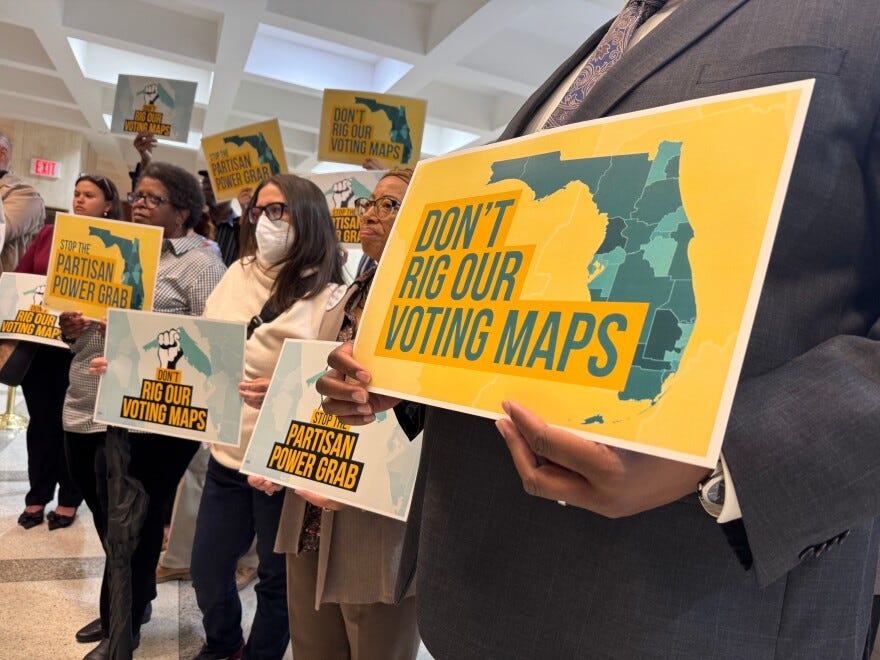
They see it as another example of partisan mapmaking designed to lock in political advantages and weaken the voices of communities that state law was intended to protect. The fight over redistricting has become one of the most important battles in modern American politics. Control of Congress often depends not only on persuading voters but also on determining where district lines are drawn.
A few changes on a map can shift the balance of power for years. Florida’s new congressional map could become one of the most consequential examples. The legal challenge sought to block the new districts from being used while broader litigation continues. Opponents argued that allowing the maps to remain in place could impact millions of voters before the courts fully determine their legality.
The Florida Supreme Court declined to intervene. The court’s majority concluded that it lacked jurisdiction over the request. That decision effectively ensures the maps will be used in next year’s elections. Only one justice dissented. Justice Jorge Labarga warned that delaying review could have serious consequences for voters.
His concern centered on the possibility that elections could proceed under maps that remain under active legal challenge. The majority disagreed. For now, the maps stand. Governor DeSantis wasted little time celebrating the outcome. He quickly declared victory on social media, highlighting the ruling as confirmation that Florida’s newly adopted districts would remain in effect.
For DeSantis, the court decision validates a strategy he has aggressively defended for years. That strategy has never been subtle. The governor has openly argued that portions of Florida’s redistricting rules should be weakened or eliminated altogether. The new congressional map significantly strengthens Republican prospects.
Of Florida’s twenty-eight congressional districts, twenty-four are now considered Republican-leaning. Several races may remain competitive. The overall structure strongly favors the GOP. That advantage could have national implications. Republicans currently hold only a narrow majority in the U.S. House of Representatives.
Every additional seat matters. Florida alone could help determine which party controls Congress after the midterms. The redistricting effort is not occurring in isolation. Across the country, both political parties have been searching for opportunities to redraw maps in their favor. Republicans have pursued aggressive redistricting strategies in several states.
Democrats have responded in states where they control the process. The result has become a nationwide arms race over political boundaries. Florida sits at the center of that fight. Critics argue that the state’s Fair Districts constitutional amendments were designed specifically to prevent this kind of partisan manipulation.
Those voter-approved provisions prohibit districts from being drawn to favor one political party over another. They also provide protections for minority representation. The organizations challenging the maps argue those protections have been violated. Their lawsuit remains active despite this week’s setback.
One of the most controversial aspects of the dispute is that DeSantis does not deny the maps were drawn with political goals in mind. Instead, he argues that portions of the Fair Districts amendments conflict with federal law. His broader objective appears to be convincing courts to narrow or weaken those constitutional protections altogether.
If successful, the implications would extend well beyond this election cycle. Several Democratic members of Congress are already feeling the effects. District boundaries across South Florida, Central Florida, and the Tampa region have been dramatically altered. Some representatives now face electorates that look very different from the ones that originally elected them.
The changes create new challenges and new uncertainties. Political careers can be reshaped overnight when district lines move. Perhaps no Democrat faces a more complicated situation than longtime Representative Debbie Wasserman Schultz. The redrawn map transformed her district so significantly that she chose to run in a different seat.
That decision has sparked criticism from Black community leaders and candidates. The district she entered was originally designed to help Black voters elect their preferred candidates. Wasserman Schultz’s entry immediately changed the dynamics of that race. The controversy highlights one of the central tensions in redistricting.
Political maps do not simply affect parties. They affect communities, representation, and access to political power. Every adjustment creates consequences that extend far beyond election statistics. Supporters of the new map argue the changes reflect legal and constitutional realities.
Opponents see a deliberate effort to dilute minority influence and maximize Republican gains. Those competing narratives are now heading toward a courtroom showdown. The broader lawsuit will continue despite the Supreme Court ruling. Future decisions could still alter the legal landscape.
What will not change is the immediate reality. The new districts will govern the 2026 elections. Candidates are already adapting their strategies. Campaigns are reorganizing. Fundraising efforts are shifting. Political calculations are being rewritten in real time.
For Republicans, the ruling represents a strategic breakthrough. For Democrats, it represents another obstacle in an already difficult electoral environment. The battle over Florida’s maps may ultimately become a national story because of what is at stake. A handful of congressional seats can determine legislative agendas, judicial confirmations, and the direction of federal policy.
The consequences stretch far beyond state borders. The court’s decision does not end the debate. It simply moves the fight into its next phase. Voting rights groups remain committed to challenging the maps. Republicans remain determined to defend them. Both sides understand the significance of what is unfolding.
The struggle is not merely about geography. It is about political power. It is about representation. It is about who gets to shape the future of Florida and, potentially, the future of Congress itself.
✍️
The lines may seem like ink on a page,
Yet they help define a political age.
Borders are drawn, districts take shape,
And sometimes democracy struggles to escape.Power rarely hides when it wins,
It steps forward and proudly grins.
Every court victory becomes a stage,
For the next battle in a larger age.The law was written to draw a line,
Between fair competition and political design.
Now courts must decide what voters meant,
When they approved those amendments.Maps create winners, maps create doubt,
Maps decide who gets pushed in or pushed out.
Every new boundary redraws the game,
Leaving old districts barely the same.
🧭 A Small Bite to Carry
Florida’s Supreme Court allowed Republican-backed congressional maps to remain in place for the 2026 midterm elections.
The new districts heavily favor Republicans and could help the GOP gain additional House seats as it seeks to maintain control of Congress.
Legal challenges continue, with opponents arguing the maps violate Florida’s anti-gerrymandering and minority representation protections.
US Stocks
Stocks climb, oil drops as Trump calls off strikes on Iran
The S&P 500, Nasdaq 100, and Russell 2000 surged after President Trump posted on Truth Social that he was calling off impending air strikes against Iran and told reporters in the Oval Office that the US and Iran will sign a peace deal soon. Oil plunged on the news.
Energy was the worst-performing sector while materials and industrials were the best performers, followed by tech.
Wholesale inflation was hotter than expected as the Producer Price Index rose by 1.1% in May, ahead of the 0.7% analysts were anticipating.
IntelINTC $116.95 (9.30%) surged after Bank of America upgraded the stock to “buy” from “underperform.”
AlibabaBABA $113.30 (-1.45%), JD.comJD $28.12 (-1.37%), and PDD HoldingsPDD $81.26 (-0.67%) slipped as a Beijing regulator cracked down on misleading promotion claims tied to China’s annual June 18 shopping festival, referred to as “618.”
What Else Are We Biting
Oracle is trying really hard to convince investors it won’t have a debt problem.
Alphabet’s Waymo is getting into the subscription — and Uber’s — business.
Opendoor’s India exit is fueling a bigger conversation about AI and outsourcing.
Biting Fact Of The Day
Tesla currently has authorization for just 69 unsupervised Robotaxis in Texas.

Florida’s new congressional map could become one of the most consequential examples. The legal challenge sought to block the new districts from being used while broader litigation continues. Opponents argued that allowing the maps to remain in place could impact millions of voters before the courts fully determine their legality.
I hit Like...but I lied about all of it