

Evening Update: Trump’s Pardoned Fundraiser Lands $106 Million Federal Deal.
Elliott Broidy—the Republican fundraiser pardoned by Trump after lobbying scandals and corruption convictions—has now secured a major Justice Department contract powered by AI surveillance.

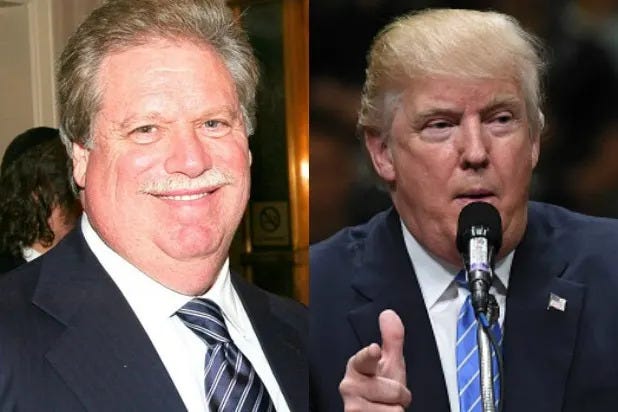
Small Bites is a reader-supported publication. To receive new posts and support my work, consider becoming a paid subscriber.
Hey Small Biters,
In Washington, scandals rarely end anymore. They simply evolve into contracts. That reality came roaring back this week after reports revealed that a company led by Elliott Broidy — the Republican fundraiser pardoned by Donald Trump during his final hours in office — has secured a $106 million federal contract from the Department of Justice.
The contract gives Broidy’s company, LEO Technologies, responsibility for using artificial intelligence to monitor, transcribe, and analyze prison phone calls for the federal Bureau of Prisons.
The optics alone are staggering. A politically connected figure with a long history of corruption scandals, foreign lobbying accusations, and criminal convictions now helping oversee one of the government’s expanding surveillance systems.
Modern Washington barely pauses anymore when these stories happen. Broidy’s political history reads almost like a running catalog of modern American influence culture. In 2020, he pleaded guilty to conspiring to violate the Foreign Agents Registration Act after secretly lobbying Trump administration officials on behalf of foreign interests tied to China and Malaysia.
Federal prosecutors said Broidy accepted millions of dollars to pressure top administration officials, including Trump himself, over sensitive international matters. The charges carried potential prison time. None of it ultimately mattered.
On January 19, 2021 — literally one day before leaving office — Donald Trump pardoned Broidy. That pardon erased the looming legal consequences before sentencing could even occur. Now, just a few years later, Broidy’s company has entered federal business at enormous scale.
The cycle feels painfully familiar. The Bureau of Prisons insists the contract followed a competitive process. Officials say six companies responded to the solicitation and stress there is no evidence Broidy’s ties to Trump directly influenced the award.
LEO Technologies also denied Broidy played any role in the bidding process itself. Technically, that may all be true. The deeper issue is not whether a direct favor occurred. It is whether America’s political culture increasingly rewards access, loyalty, and proximity to power regardless of prior misconduct.
That perception now defines public trust in Washington almost as much as actual corruption itself. The company itself specializes in AI-driven prison surveillance systems. Its website describes prisoner communications as “the world’s largest concentration of criminally-minded activity.”
The technology will reportedly translate, transcribe, and monitor prison phone calls automatically. The expansion of AI surveillance into prison systems raises enormous civil-liberties questions already. Broidy’s involvement intensifies those concerns dramatically. This is not Broidy’s first corruption scandal.
Far from it. Back in 2009, he pleaded guilty in New York after prosecutors accused him of paying nearly $1 million in bribes to state officials connected to pension-fund business deals. The allegations sounded almost cartoonish in excess.
Luxury trips to Israel and Italy. Secret investments. Political favors. The kind of corruption story Americans claim to hate while repeatedly watching the same players resurface years later wealthier than before. A judge later reduced the conviction to a misdemeanor.
Soon afterward, Broidy reinvented himself politically and became a major Trump fundraiser and Republican National Committee official. Rehabilitation in Washington often moves astonishingly fast when money and connections remain intact. Then came the personal scandals.
In 2018, Broidy resigned from his Republican fundraising role after reports surfaced that he had agreed to pay $1.6 million to a former Playboy model following an affair and abortion.
That payment was reportedly arranged through Trump’s former attorney Michael Cohen — the same lawyer involved in hush-money payments to Stormy Daniels before the 2016 election. The overlap almost feels symbolic now.
A small political universe where scandal, money, loyalty, and legal maneuvering continuously orbit one another. Yet the deeper controversies surrounding Broidy extended far beyond tabloid headlines. Leaked emails later exposed his work alongside UAE adviser George Nader in efforts reportedly aimed at influencing Trump administration policy on behalf of Gulf interests.
Broidy denied wrongdoing repeatedly. The allegations nevertheless deepened concerns about foreign influence surrounding Trump-era political networks. Perhaps the most remarkable part of this entire story is how ordinary it now feels politically.
A pardoned political insider with multiple scandals receives a major federal contract involving sensitive surveillance systems. Few people even seem surprised anymore. That numbness may be the most dangerous development of all.
Public outrage loses force when scandal becomes constant background noise. Americans increasingly absorb stories like this with exhaustion instead of shock. Another contract. Another insider. Another pardon. Another return to power.
The cycle repeats until accountability itself starts feeling fictional. The AI element adds another unsettling layer. Governments worldwide are rapidly expanding automated surveillance technologies into prisons, policing, immigration systems, and intelligence operations. Companies positioned inside that growth sector stand to make enormous profits.
LEO Technologies now enters that landscape through a massive federal foothold. Critics increasingly worry AI surveillance systems often expand far faster than public oversight or legal protections. The prison population becomes an easy testing ground because incarcerated people possess limited political power and diminished privacy protections already.
Monitoring systems introduced there rarely stay confined forever. Technologies built for prisons often eventually migrate outward into broader society. History repeatedly shows that pattern. Trump’s pardon power itself remains central to the story.
Presidential pardons exist constitutionally for legitimate reasons: correcting injustice, showing mercy, or addressing prosecutorial excess. Critics argue Trump increasingly used pardons as political rewards for allies and loyalists connected to his orbit. Broidy became one of the clearest examples.
Federal prosecutors from Trump’s own Justice Department stated explicitly that Broidy had agreed to lobby the president and high-ranking officials for foreign interests in exchange for millions. Then the president erased the consequences personally.
Years later, the beneficiary of that pardon now profits through a federal contract awarded by another branch of the same government. The symbolism practically writes itself. None of this proves direct corruption in the contract itself. That distinction matters legally.
Still, politically and ethically, the situation reinforces a growing public belief that elite accountability operates differently than ordinary accountability. Most Americans understand instinctively that their own lives would likely collapse permanently after multiple corruption scandals and criminal convictions.
Political insiders often seem to recover faster than ever. Connections survive. Influence survives. Money survives. Eventually power returns too. That reality corrodes trust steadily. The Bureau of Prisons contract may ultimately function exactly as officials claim — a legally awarded agreement for specialized technology services.
Yet the broader story surrounding it reflects something larger about modern American politics. Scandal no longer reliably destroys careers. It often merely interrupts them temporarily. In a healthier political culture, repeated corruption controversies might permanently disqualify people from sensitive government-connected work.
In today’s America, they sometimes become strange qualifications instead. Experience. Connections. Survival. Influence. The public notices that pattern even when institutions pretend not to. Elliott Broidy now sits once again near the machinery of federal power.
This time through AI surveillance and prison monitoring. The details may shift. The lesson feels depressingly familiar. In modern Washington, scandals rarely end careers.
Sometimes they simply become another chapter before the next contract arrives.
✍️
The scandal fades, the headlines dim,
yet power quietly returns to him,
through contracts signed behind the wall,
where consequences rarely fall.The papers filed, the cameras flash,
the outrage burns and quickly ash,
because in modern halls of fame,
survival often beats out shame.The algorithms quietly hear,
each whispered word, each hidden fear,
while somewhere profits rise once more,
through systems built to watch the poor.The doors revolve without a sound,
where fallen names come back around,
through wealth that cushions every fall,
while ordinary lives lose all.
🧭 A Small Bite to Carry
Elliott Broidy, the Republican fundraiser pardoned by Donald Trump after pleading guilty in a foreign lobbying case, now leads a company awarded a $106 million Justice Department contract.
Broidy’s company, LEO Technologies, will use artificial intelligence to monitor, transcribe, and analyze federal prison phone calls.
The contract reignited concerns about political influence, elite accountability, and the growing expansion of AI-driven government surveillance systems.

Federal prosecutors said Broidy accepted millions of dollars to pressure top administration officials, including Trump himself, over sensitive international matters. The charges carried potential prison time. None of it ultimately mattered.