

Evening Update: Trump’s DHS May Hold America’s Airports Hostage Over Immigration Politics.
A shocking new proposal from Homeland Security could disrupt international travel, damage the economy, and turn major US airports into weapons in the administration’s war against sanctuary cities.

Small Bites is a reader-supported publication. To receive new posts and support my work, consider becoming a paid subscriber.
Hey Small Biters,
America’s airports may soon become political battlegrounds. Not because of terrorism. Not because of another pandemic. Because the Trump administration is reportedly considering using international air travel as leverage against cities that refuse to cooperate fully with immigration enforcement.
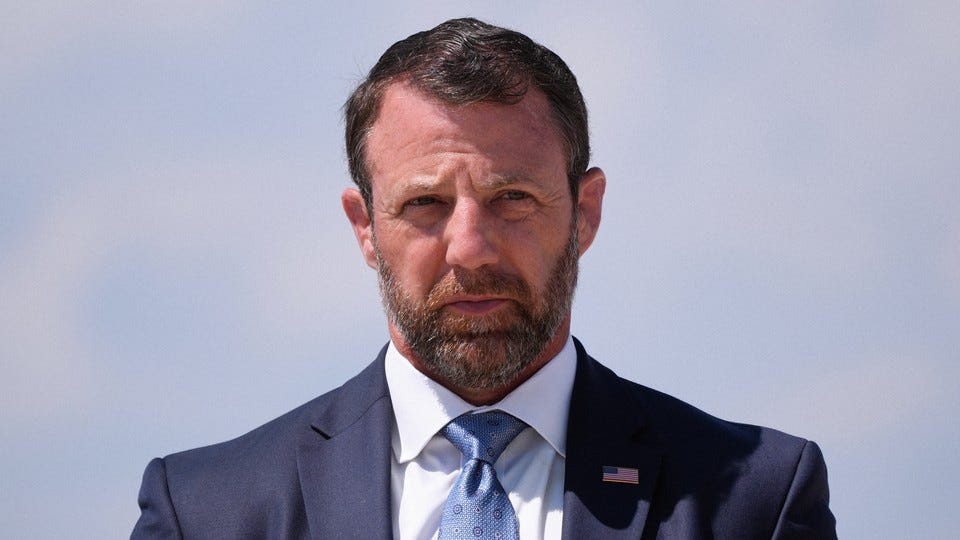
According to a new report, Homeland Security Secretary Markwayne Mullin privately warned airline and travel executives that the administration may reduce federal customs and border staffing at airports located in so-called sanctuary jurisdictions.
The implications are enormous. Less staffing means slower screening. Slower screening means severe delays. Severe delays mean canceled international flights, crippled tourism, supply-chain disruptions, and economic chaos spreading across major American cities.
All of it tied directly to immigration politics. The airports reportedly under discussion include some of the busiest and most economically critical in the country: JFK, Newark, Washington Dulles, and Portland International Airport.
Those are not minor regional hubs. They are arteries of the global economy. Every day millions of passengers, cargo shipments, medical supplies, business travelers, and tourists move through them. Any disruption would ripple far beyond the cities being targeted.
Travel executives reportedly left the DHS meeting alarmed, warning the proposal could devastate the airline industry and create widespread economic fallout. One executive described the proposal bluntly: “devastating.” That word may not even capture the scale fully.
The administration frames the proposal as pressure against sanctuary policies. Trump officials want cities to cooperate more aggressively with ICE by allowing easier transfers of detainees from local jails into federal immigration custody. Mullin publicly described the idea weeks ago during a Fox News appearance.
“If they’re a sanctuary city and they’re receiving international flights… maybe we need to have a really hard look at that,” he said. That “hard look” now appears dangerously real. The logistical problems with the proposal are staggering.
International airports do not operate like isolated bus stations where traffic can simply shift elsewhere overnight. Global flight routes rely on years of infrastructure planning, staffing coordination, gate availability, customs processing, and interconnected scheduling systems.
Experts interviewed in the report repeatedly emphasized that rerouting large-scale international traffic would create massive bottlenecks immediately. Florida and Texas airports cannot magically absorb displaced traffic from New York, Los Angeles, Chicago, or Washington DC.
There are not enough gates. Not enough staff. Not enough capacity. Not enough transportation infrastructure. The administration appears to believe economic pain directed at sanctuary cities will force political compliance.
Critics argue the proposal instead punishes the entire country. The irony inside the plan borders on absurdity. Many sanctuary cities are also America’s largest international economic hubs. Punishing them means punishing tourism, global business travel, international students, supply chains, conventions, exports, and cargo distribution.
A German traveler flying into JFK may not even stay in New York. They could be connecting to Cincinnati. A Korean family arriving in Los Angeles might be heading to Orlando. International travel systems are interconnected nationally.
Damage spreads quickly. Even conservative travel-industry analysts expressed confusion about how the administration expects the strategy to function practically. The proposal increasingly resembles political theater colliding with operational reality.
California Governor Gavin Newsom immediately blasted the plan publicly, calling it “a stupid idea” that would worsen economic strain already tied to rising fuel prices and global instability. Yet inside the administration, the pressure campaign appears very real. The deeper context surrounding the proposal matters enormously.
Trump’s second-term deportation campaign has struggled politically and operationally. Earlier efforts involving aggressive ICE and Border Patrol deployments into cities like Minneapolis, Los Angeles, and Chicago created backlash, protests, and deadly confrontations.
Poll numbers on immigration have also softened. Mass deportation sounded simpler during campaign rallies than in reality. The administration now appears increasingly desperate to find new leverage points against local governments resisting cooperation. Airports may simply be the next battlefield.
This strategy also reflects a broader transformation inside American governance itself. Federal infrastructure increasingly becomes a political weapon. Funding threats. Transportation threats. Federal investigations. Military deployments.
Licensing pressure. The boundaries between governance and coercion continue blurring. Another layer of irony hangs over the timing. The United States is currently preparing to co-host the World Cup alongside Mexico and Canada. DHS itself expects roughly seven million international travelers during the tournament.
Officials already worry about overwhelming airport congestion, security screening delays, and border-processing strain. Now the same administration managing those enormous responsibilities is simultaneously considering reducing staffing at key international gateways. That contradiction reveals the internal chaos surrounding immigration politics right now.
One part of the government promotes global tourism and international prestige. Another part threatens to choke off airport operations for political pressure. The public sees the confusion clearly.
Even some DHS officials reportedly remain skeptical the plan will move forward fully. Privately, concerns are growing that the administration risks repeating earlier political disasters involving airport chaos.
Trump’s first-term “Muslim ban” triggered massive protests and operational breakdowns at airports nationwide. Long TSA lines during past government shutdowns also produced political backlash quickly.
Airports are uniquely visible symbols of government competence. When they fail publicly, millions of people feel it immediately. That reality may ultimately restrain the administration. Or it may not. The proposal also exposes a growing authoritarian instinct inside modern American politics: using broad systems affecting ordinary people as pressure tools in ideological wars.
The intended targets are city governments. The actual victims would likely be travelers, workers, airlines, businesses, immigrants, tourists, and local economies. Collective punishment rarely stays neatly targeted.
The administration insists sanctuary cities create public-safety dangers by refusing deeper cooperation with ICE. Supporters argue local governments should not obstruct federal immigration enforcement while simultaneously benefiting from international commerce and federal infrastructure.
Opponents counter that the proposal weaponizes transportation systems in ways more commonly associated with unstable governments than functioning democracies. That debate cuts directly into America’s increasingly fractured political identity.
Is government infrastructure a public good? Or simply another lever of partisan control? The answer increasingly depends on who currently holds power. What makes the proposal especially dangerous is how quickly it normalizes escalation. Once airports become political leverage points, where does it stop?
Ports? Rail systems? Disaster aid? Federal communications networks? The logic spreads easily once accepted. The administration has not formally approved the airport plan yet. Still, the fact that major travel executives were privately briefed on it signals something important:
This is no longer idle rhetoric. It is active policy consideration. America’s airports may soon become the latest front line in a widening war over immigration, federal authority, and political obedience. Millions of travelers could end up caught in the middle.
Because in modern America, even boarding a plane may no longer escape politics.
✍️
The terminals hum beneath the light,
while politics prepares the fight,
through crowded gates and endless lines,
where power redraws the warning signs.First comes the threat wrapped up in pride,
then policy shifts behind the side,
until the public wakes to see,
the leverage shaping what should be free.The planes still cross the open sky,
while leaders gamble low and high,
with systems built through years of strain,
now threatened for political gain.The crowd is told who bears the blame,
while systems buckle just the same,
and every delay, every missed flight,
becomes another staged political fight.
🧭 A Small Bite to Carry
Homeland Security Secretary Markwayne Mullin reportedly warned airline executives that DHS may reduce customs staffing at airports in sanctuary cities like New York, Portland, and Washington DC.
Travel industry leaders fear the proposal could create massive airport delays, flight cancellations, economic disruption, and nationwide ripple effects across tourism and cargo systems.
Critics argue the administration is increasingly using federal infrastructure and public systems as political weapons in its immigration enforcement campaign.

Homeland Security Secretary Markwayne Mullin privately warned airline and travel executives that the administration may reduce federal customs and border staffing at airports located in so-called sanctuary jurisdictions.
These same executives need to lean on Congress. Hard. As long as corporations have the right to buy politicians, thanks to the USSC, maybe they need to remind those politicians who owns them.