

Evening Update: Strait of Fire
A downed U.S. military helicopter, rising tensions in the Gulf, and renewed threats of retaliation push the Iran conflict closer to another dangerous turning point.

Small Bites is a reader-supported publication. To receive new posts and support my work, consider becoming a paid subscriber.
Hey Small Biters,
The fragile calm surrounding the Iran conflict may have shattered once again. Donald Trump escalated tensions Tuesday after publicly blaming Iran for the loss of a U.S. Army Apache helicopter near the Strait of Hormuz. His accusation came with a blunt warning: the United States would not allow the incident to pass without a response.
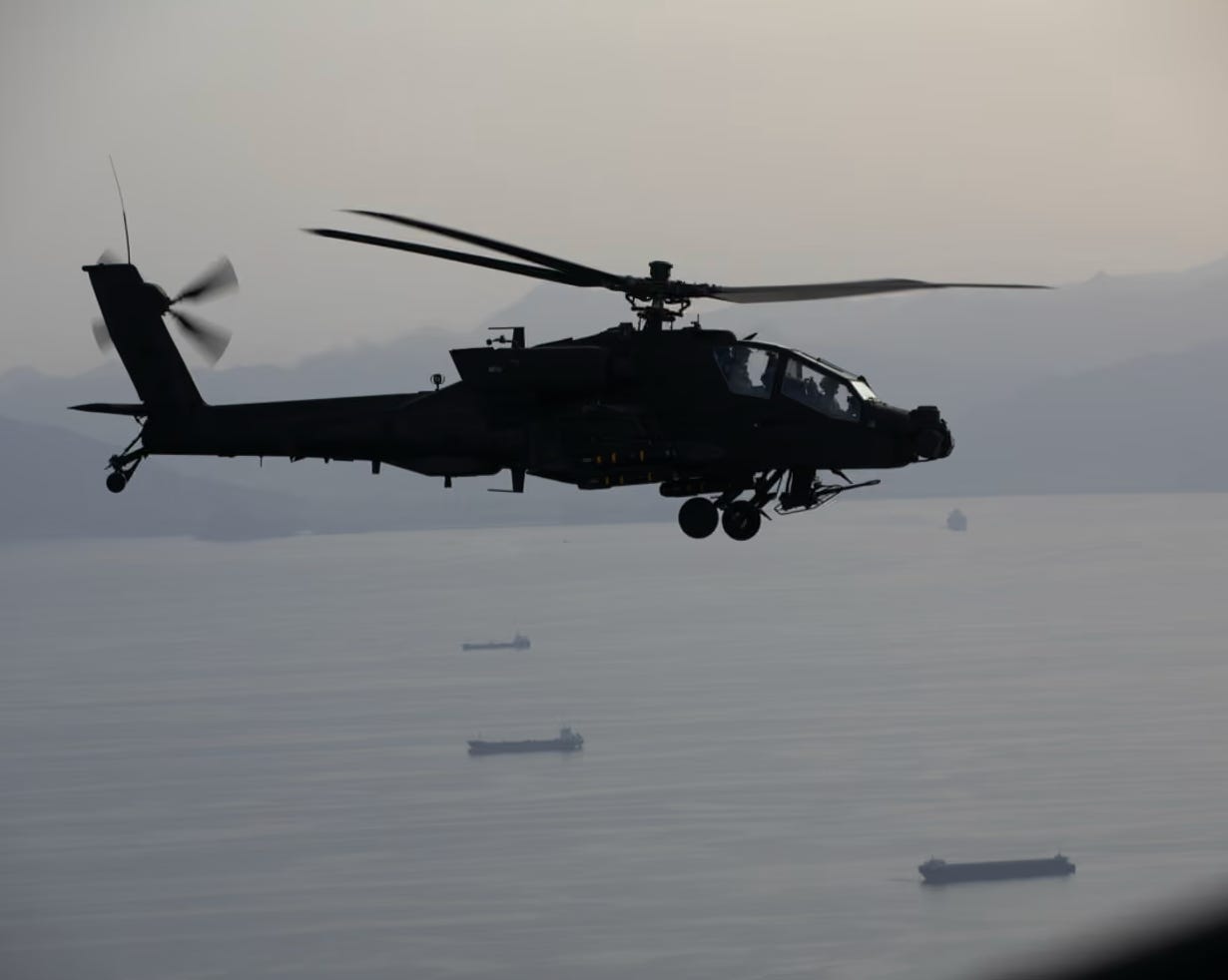
The helicopter crashed in the early morning hours off the coast of Oman during what military officials described as a routine patrol mission. At first, military authorities offered few details. Investigators announced only that the aircraft had gone down and that an inquiry into the cause was underway. No immediate indication of hostile fire was provided by U.S. Central Command.
That changed when Trump posted a statement on social media claiming Iranian forces had shot down the aircraft. According to the president, he had been informed by military officials that Iran was responsible for the incident. Trump emphasized that both crew members survived but insisted the attack could not go unanswered.
His statement immediately intensified fears that the already volatile conflict could spiral into another round of military escalation. The good news came quickly. Both aviators survived the crash and were rescued after spending approximately two hours in the water. Their recovery became a historic event in its own right.
Military officials revealed that an unmanned drone vessel located the stranded crew members and helped coordinate their rescue. The operation is believed to be the first successful sea rescue involving a U.S. military drone boat. The rescue highlighted how rapidly warfare and military operations are changing.
Machines increasingly perform missions that once required additional personnel to be placed in harm’s way. Even amid crisis, technology continues reshaping the battlefield. The aircraft involved was an AH-64 Apache, one of the most recognizable attack helicopters in the American arsenal.
For decades, Apaches have served as critical assets in combat operations around the world. Their presence in the Gulf region has expanded significantly during the current conflict. The helicopters have been used to patrol shipping lanes, enforce restrictions on Iranian oil movements, and assist regional allies in countering drone threats.
Losing one under suspicious circumstances immediately raises serious questions. The incident occurred against the backdrop of a ceasefire already showing signs of collapse. Just one day earlier, Israel and Iran exchanged fire in one of the most serious violations of the truce established months ago.
Those attacks resulted in additional casualties and renewed concerns that negotiations are rapidly losing momentum. Despite repeated diplomatic efforts, officials have struggled to convert temporary pauses in fighting into a lasting peace agreement. Every new confrontation increases the risk that diplomacy will be pushed aside entirely.
The Strait of Hormuz remains central to the crisis. The narrow waterway handles a significant portion of the world’s oil shipments, making it one of the most strategically important locations on Earth. Any military incident there immediately attracts global attention. Energy traders, governments, and military planners closely monitor every development.
Disruptions in the region can quickly affect fuel prices, shipping costs, and inflation worldwide. The economic consequences have already been substantial. Since the conflict intensified earlier this year, energy prices have risen significantly. Consumers around the globe have felt the impact through higher transportation costs, increased utility bills, and more expensive food prices.
Wars fought thousands of miles away often find their way into household budgets. The Strait of Hormuz has become a vivid example of that reality. What makes Trump’s accusation particularly significant is the timing. Only hours before blaming Iran for the helicopter crash, the president had expressed optimism about ongoing negotiations.
He suggested a breakthrough agreement might be possible within days. Trump described the prospects for a deal as strong and repeatedly emphasized his preference for diplomacy over expanded military action. His comments reflected a familiar pattern.
For months, he has alternated between threats of overwhelming force and predictions that peace is just around the corner. The helicopter incident now threatens to derail that narrative. If evidence ultimately supports Trump’s claim, pressure for retaliation will intensify dramatically.
If evidence remains unclear, questions may emerge about whether the administration acted too quickly in assigning blame. Military investigators continue examining the crash. Officials have not yet publicly released findings confirming what caused the aircraft to go down.
That uncertainty remains important. History offers numerous examples of incidents that initially appeared straightforward but later proved more complicated. Facts gathered during investigations often shape the course of international crises.
The challenge is that political leaders rarely wait for every fact before making decisions. The broader conflict remains deeply unstable. Israel continues military operations against Iranian-linked forces across the region. Hezbollah remains active in Lebanon. Iran continues resisting demands related to its nuclear program.
American forces maintain a significant presence throughout the Gulf. Every actor involved faces pressure from domestic audiences and strategic interests. Those overlapping tensions create countless opportunities for miscalculation. One misunderstood action can quickly trigger a chain reaction.
That reality is what worries military analysts most. The downing of a helicopter is not merely an isolated event. It becomes another piece of a larger puzzle involving regional power struggles, energy markets, diplomatic negotiations, and military deterrence. Each new incident raises the stakes. Each response creates fresh risks.
For now, the two rescued pilots are safe. The investigation continues. Diplomats are still talking. Yet the atmosphere surrounding the conflict feels increasingly fragile. The president has promised a response. Iran has not accepted responsibility.
The world is once again watching the Strait of Hormuz and wondering whether the next move will bring negotiations closer—or push the region deeper into confrontation.
✍️
One spark above a troubled sea,
Can ignite what nations fear to see.
One aircraft falling from the sky,
Can turn diplomacy into a battle cry.Steel wings carry power and pride,
Guarding waters far and wide.
When one falls from the sky above,
Leaders rarely respond with love.The cost of conflict rarely stays,
Upon the battlefield for days.
It travels roads and market stalls,
And reaches homes beyond the walls.Truth moves slowly through the night,
While politics prepares to fight.
Evidence follows where emotions lead,
And urgency often outruns need.
🧭 A Small Bite to Carry
Trump blamed Iran for the crash of a U.S. Apache helicopter near the Strait of Hormuz and warned that America would respond.
Both crew members survived and were rescued in what officials described as the first known U.S. military drone-assisted sea rescue.
The incident comes as ceasefire violations, regional fighting, and stalled negotiations continue raising fears of a broader conflict.

The helicopter crashed in the early morning hours off the coast of Oman during what military officials described as a routine patrol mission. At first, military authorities offered few details. Investigators announced only that the aircraft had gone down and that an inquiry into the cause was underway. No immediate indication of hostile fire was provided by U.S. Central Command.