


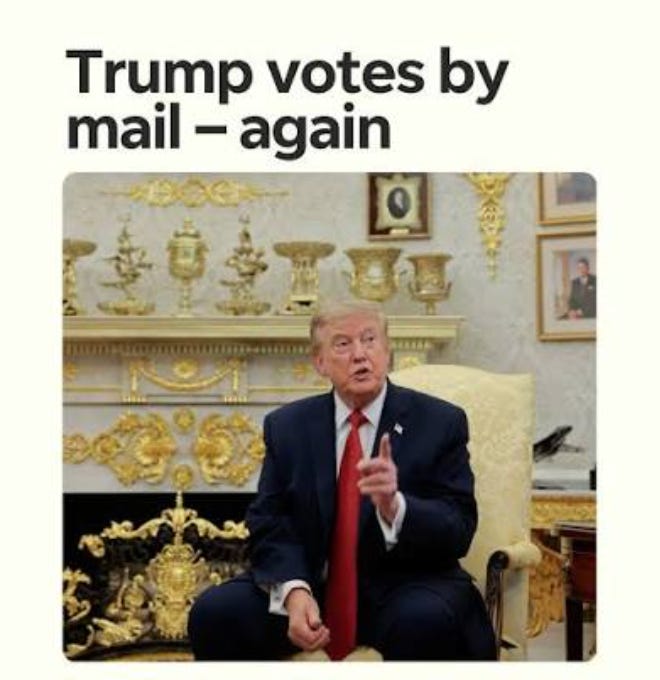
Trump Votes by Mail While His Administration Is Fighting to Restrict Mail Voting
The White House spent part of today defending President Trump after reports that he cast his Florida Republican primary ballot by mail. That would ordinarily be completely unremarkable, except Trump has spent years attacking mail voting and his administration is currently fighting in court to impose new restrictions on it. The White House says Trump followed Florida law and argues there is no contradiction. Democrats see something considerably simpler: a president using a voting method for himself while trying to make that same method harder for other Americans to use.
Florida’s Election Today Is a Major Test of Trump’s Power Inside the Republican Party
Florida voters are choosing nominees for governor, Senate and Congress today, making this one of the most important remaining primary nights before November. Trump has endorsed Rep. Byron Donalds for governor and Sen. Ashley Moody, while Democrats are sorting through candidates hoping to make Florida competitive again. The congressional races are equally consequential because Republican-drawn maps could hand the GOP several additional House seats. Florida may be Trump’s adopted home state, but tonight’s results will show how much his endorsement still moves Republican voters when his own name isn’t on the ballot.
Alaska Could Suddenly Become a Serious Democratic Senate Opportunity
Alaska is voting today too, and Democrats are watching former Rep. Mary Peltola’s Senate campaign very closely. Republican Sen. Dan Sullivan remains formidable, but Alaska’s unusual top-four primary and ranked-choice general election make the race less predictable than a conventional red-state contest. Democrats desperately need places where they can expand the Senate map rather than merely defend their existing seats. Alaska isn’t supposed to be easy territory for them—which is exactly why a competitive race there would make Republicans nervous.
Disney Sues Trump’s FCC, Accusing the Government of Retaliating Against ABC
The parent company of ABC has taken the Trump administration to court, arguing that the Federal Communications Commission improperly targeted its broadcast licenses because administration officials disliked the network’s coverage and political satire. The dispute is quickly becoming a major First Amendment test. The government has broad regulatory authority over broadcasters, but using that authority to punish a news organization for speech would be another matter entirely. The case therefore asks a question much larger than what happens to ABC: how far can a president’s regulators go against media outlets the president openly dislikes?
Trump Says There Are No Iran Talks Planned as the War Slides Back Toward Confrontation
Any optimism that Washington and Tehran were inching toward a durable settlement is fading again. Trump said today that the United States currently has no negotiations planned with Iran, while insisting that shipping through the Strait of Hormuz remains possible. Oil markets aren’t exactly sharing the president’s confidence. Crude prices have climbed again following the expiration of the ceasefire and Trump’s increasingly aggressive rhetoric. After months of war, ceasefires, deadlines and attempted negotiations, Washington is once again facing the same uncomfortable question: what exactly ends this conflict?
Trump’s Threat Against Oman Is Now Creating a Much Bigger Foreign-Policy Problem
More details emerged today about Trump’s extraordinary threat to bomb Oman, a longtime American partner that has frequently served as a mediator between Washington and Tehran. Trump was reportedly angered by Oman’s negotiations with Iran over management of shipping through the Strait of Hormuz. The threat matters beyond one presidential outburst. Oman has been useful precisely because it can speak to both Washington and Tehran. Threatening the mediator while simultaneously complaining that diplomacy isn’t working is not exactly the easiest way to create more diplomatic options.
Trump’s South Korea Decision Is Starting to Rattle One of America’s Most Important Asian Alliances
South Korean President Lee Jae Myung publicly stressed the importance of the U.S. alliance today after Trump’s decision to reduce joint military exercises. Trump linked the decision partly to South Korea’s refusal to join the Iran war and also pointed to his relationship with North Korean leader Kim Jong Un. In Seoul, the reaction has gone well beyond disappointment: Lee is again talking about South Korea taking greater independent control of its military. What Washington describes as a change in exercises could therefore accelerate a much larger rethink of America’s security relationship with South Korea.
Whistleblower Says Trump Administration Pressured Officials to Build Cases Against Universities
A former Justice Department official is alleging political pressure inside the administration’s antisemitism task force, saying officials pushed investigators toward settlements with elite universities even when career staff believed the evidence did not support the government’s claims. The administration has made confronting antisemitism on college campuses a major priority. But the whistleblower’s allegations shift the argument from whether universities adequately protected Jewish students to whether federal civil-rights enforcement itself was being manipulated to punish institutions politically disliked by the White House.
Trump’s 50% Canada Tariffs Are Hours Away, and Negotiators Are Scrambling for a Deal
American and Canadian officials are holding last-minute negotiations before Trump’s threatened 50% tariffs on roughly $20 billion of Canadian goods take effect early Wednesday. This isn’t some distant trade dispute: Canada is one of America’s largest trading partners, meaning substantially higher tariffs can quickly spill into prices, supply chains and businesses on both sides of the border. Trump sees tariffs as leverage. Businesses increasingly see them as another layer of uncertainty at a time when voters are already unhappy about the cost of living.
The Housing Market Is Sending Washington Another Warning About the Economy
New government data released today show single-family housing construction falling to its weakest pace since November 2022. Building permits improved, so the picture isn’t entirely bleak, but high borrowing costs and affordability problems continue to weigh heavily on housing. Politically, this matters because housing has become one of those issues where official economic statistics and people’s daily experiences collide. A voter who can’t afford a mortgage—or whose adult children can’t afford their first home—is unlikely to be comforted by Washington telling them the broader economy is doing fine.
Everything now is a “DEAL.” It’s a stupid term to use regarding negotiations between nations. It’s a Trumpism, and we don’t have to get in line. It is a term that lessens the human factor. It’s a term for Online Gambling, for purchases of goods,etc. It removes the fact that people are affected by the different agreements arrived at. It’s not only about money. This administration is only about money, and about money to the already wealthy.
47 said there’s only money for War and for him.
By the way, the cost of
Airplane fuel has gone up 70%. 47 just purchased more giant airplanes for his various minions. And my tax money goes to that and the fuel to fly them to Vance’s kid’s golf lesson, and Patel’s girlfriend.