

Cuba Is Next
While wars rage elsewhere, Washington is quietly setting the stage for another front—just 90 miles from home.

Small Bites is a reader-supported publication. To receive new posts and support my work, consider becoming a paid subscriber.
Hey Small Biters,
It begins not with troops on beaches, but with a tanker at sea.
A Russian oil vessel, heavy with crude, is inching its way across the Atlantic toward Cuba. It is not just cargo—it is leverage. And it may never arrive. The U.S. Navy is already positioning itself to intercept, to choke off supply, to tighten the grip.
This is not diplomacy. It is pressure, calibrated and escalating.
The Trump administration is squeezing Cuba toward a breaking point, betting that economic collapse will succeed where decades of sanctions have not. The goal is not subtle. It is control—over leadership, over markets, over what comes next.
And Trump is not hiding it.
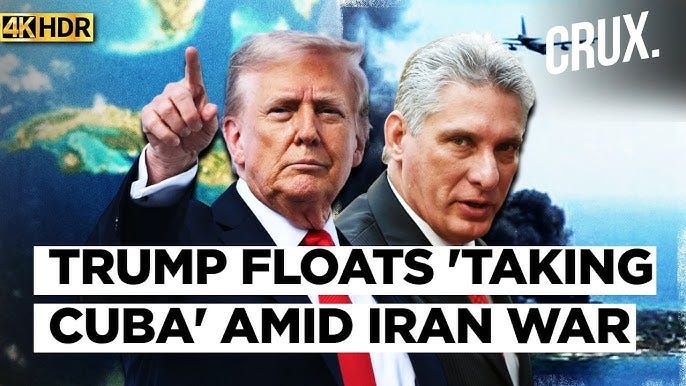
He has openly suggested he could “take” Cuba, framing the island less as a sovereign nation and more as an opportunity. Whether through force, pressure, or negotiation seems almost secondary.
Cuba, already fragile, is cracking.
Blackouts stretch across entire cities. Food shortages deepen. Hospitals struggle. Fuel is scarce. What was once a slow decline has become a free fall, accelerated by global pressures and internal failures alike.
More than a million people have already left the island in recent years. Another wave is waiting, just beneath the surface, ready to move if conditions worsen.
And that is precisely the point.
Washington sees vulnerability and calls it leverage.
The administration believes that economic desperation will force Havana to the table—or force it to its knees. Talks have begun, but they are fragile, shadowed by the possibility that negotiation is merely a prelude.
Because there is another plan.
Behind the scenes, preparations are advancing for something far more aggressive. Legal groundwork is being laid. Indictments are reportedly in motion against Cuban leadership, echoing tactics used previously in Venezuela.
The pattern is familiar.
First isolate,
then indict,
then act.
Officials have described the Venezuela operation as a “dry run.” Cuba, they suggest, could be next. Not necessarily a full-scale invasion, but a targeted intervention—just enough to reshape the system without fully dismantling it.
This is not about ideology alone. It is about economics.
The vision being discussed is less revolution and more reorganization. Not the collapse of the state, but its restructuring—what one observer described as putting an entire country through “Chapter 11.”
Keep it standing. Change who benefits.
There is money on the table. Billions, according to officials. Tourism, real estate, infrastructure—Cuba is seen not just as a geopolitical prize, but as a market waiting to be opened.
Trump’s interest in the island predates his presidency. Business opportunities, branded developments, commercial expansion—these are not new ideas. They are unfinished ones.
And now, they may have a pathway.
But the reality on the ground is far less abstract.
Cuba is teetering. Power grids are failing. Water systems are strained. Garbage piles up in cities where basic services have collapsed. The United Nations has warned of a potential systemic breakdown.
This is not a stable platform for transformation. It is a crisis.
Yet within that crisis lies the administration’s opportunity.
Influential Cuban American voices are urging action, seeing a moment to finally dismantle a regime that has endured for decades. Others, including many within Cuba, are less interested in political upheaval than in simple survival.
They do not want a new system imposed. They want the current one to work.
That distinction matters—but it may not shape the outcome.
Inside Washington, discussions are already turning to who might lead a post-transition Cuba. Names are being floated. Scenarios are being drafted. The future is being sketched before the present has resolved.
At the same time, Cuba is not standing still. Its officials are reaching outward—toward diplomats, analysts, anyone who might influence the narrative or buy time. They understand the stakes.
They also understand the pattern.
Negotiation, followed by escalation, followed by intervention.
And all of this is unfolding while the United States is already engaged elsewhere. War with Iran. Residual tensions in Venezuela. A military stretched across regions.
The question is not just whether the U.S. can act.
It is whether it can sustain the consequences.
Russia, for its part, appears to be testing the boundaries. The tanker moving toward Cuba is not just a shipment—it is a signal. A reminder that this is not a vacuum, and that others are watching, calculating, probing.
The administration’s strategy assumes control—over timing, over escalation, over outcome. But history suggests otherwise.
Regime change is rarely clean. Economic pressure does not always produce compliance. And once a confrontation begins, it rarely follows a script.
Cuba sits just 90 miles from Florida, close enough to feel immediate, far enough to be treated as strategic.
But proximity cuts both ways.
What happens there will not stay there.
As the tanker moves closer, as the pressure builds, as plans solidify, one thing becomes clear: this is no longer speculation.
It is preparation.
And the only remaining question is whether the next step will be taken quietly—or all at once.
✍️
An island in the dark,
and someone calls it potential.
Someone else calls it prey.Decisions made in rooms,
for people not in them.
🧭 A Small Bite to Carry
The U.S. is escalating pressure on Cuba, potentially setting the stage for regime change.
Economic collapse is being used as leverage, with legal and military options under consideration.
Strategic interests—including business and geopolitics—are driving a high-risk approach close to home.
US Stocks
Stocks sink as the war escalates; Russell 2000 enters correction territory
Stocks sank and oil prices rose as the war in the Middle East escalated, with the US deploying more troops and warships. All stocks in the Magnificent 7 fell for the second consecutive day. Financials was the best-performing sector.
The S&P 500 closed lower for the fourth consecutive week. The Russell 2000 officially entered correction territory.
BitcoinBTC $68,327.91 (0.37%) remained stuck in the $70,000 level, and bitcoin ETFs experienced their second consecutive day of outflows yesterday with a $90 million exodus. Altcoins also continued their slide.
The inflationary pressure pushing the Fed away from further rate cuts continued to hit precious metals and miners. The SPDR Gold Shares ETFGLD $412.74 (-3.05%) and iShares Silver TrustSLV $61.62 (-6.35%) both fell, and producers like NewmontNEM $95.77 (-3.45%) and Freeport-McMoRanFCX $52.35 (-2.83%) also continued to drop.
The market seems to be pricing in some chance of an unpleasant replay, with short-term interest rates spiking and prediction markets broadcasting a 39% chance the central bank hikes rates in July.
What Else Are We Biting
Super Micro dives after cofounder charged with allegedly smuggling AI chips to China.
Tesla and SpaceX to jointly run “most epic chip-building exercise in history by far”.
Microsoft rolls back some of its Copilot AI bloat on Windows.
Biting Fact Of The Day
Apple will rake in $1 billion in App Store fees this year from other companies’ generative-AI apps.

He has openly suggested he could “take” Cuba, framing the island less as a sovereign nation and more as an opportunity. Whether through force, pressure, or negotiation seems almost secondary.